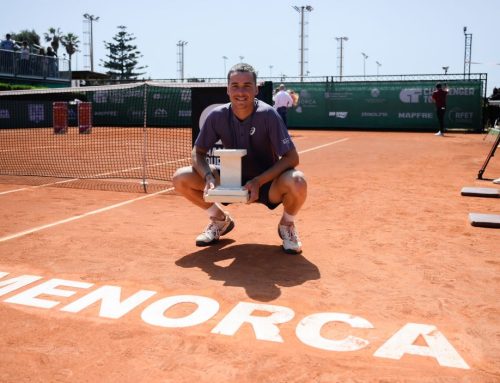
Carlos Taberner: from a stumble in Menorca to a firm comeback

The Spaniard embarks on a steady climb of 71 places after his quarter‑final exit at the Open Menorca ATP Challenger 100
The Open Menorca ATP Challenger 100 isn’t just another stop on the tour—it’s a launchpad where careers can be rebooted. And in the 2025 edition, though Carlos Taberner exited earlier than expected, his subsequent performance proved that a loss can sometimes spark a remarkable rebound.
The Valencian player began the season ranked No. 174 and entered Menorca as the fifth seed. After falling in the quarter‑finals to Pol Martín Tifón, that defeat became the catalyst for one of his most consistent stretches of the year, propelling him to No. 103 by 17 November 2025—an impressive rise of 71 places.
Menorca: a setback with positive fallout
From 31 March to 6 April, the first edition of the Open Menorca ATP Challenger 100 took place. Taberner arrived with experience and a record of seven Challenger titles, making him a clear favourite in Ciutadella.
Yet, in the quarter‑finals he ran into a spirited Pol Martín Tifón, who went on to finish as runner‑up. The defeat was unexpected and hard to digest—but sometimes setbacks reveal true character. For Taberner, it was the beginning of a renewed push that would carry him through the season with resilience and determination.
The recovery begins in Oeiras
Less than a week after Menorca, on 14 April, Taberner reached the semifinals of the Challenger in Oeiras (Portugal). He bowed out to Francisco Comesaña 1–6, 2–6, but the performance already showed signs of regained confidence and rhythm—proof that he was not derailed.
Back into the big league: Rome appearance
His next significant appearance was at the ATP Masters 1000 in Rome. On 5 May, he entered the main draw and faced Australia’s Alexei Popyrin (25), losing 1–6, 6–7(4). It wasn’t a win, but the fact he qualified to compete at a Masters 1000 event highlighted his determination to reestablish himself at higher levels.
Summer breakthrough: runner-up in Umag
The season’s highlight came on 21 July, when Taberner reached the final of the ATP 250 tournament in Umag, Croatia. He delivered his best campaign at this tier, ultimately losing to Italy’s Luciano Darderi (46) 3–6, 3–6.
This run paid off: by 4 August he climbed to No. 83, his best ranking of 2025, placing him once again among the élite challengers vying to rejoin the Top 80.
Consistency through the fall: Cordenons, Seville, Valencia and Montevideo
Rather than fading, Taberner maintained steady form across multiple tournaments, often reaching the latter rounds:
- Cordenons (Italy), 4 August: Semi‑finals, lost to Lukas Neumayer (170) 1–6, 3–6.
- Seville, 1 September: Quarter‑finals, defeated by Ignacio Buse (135) 3–6, 2–6.
- Valencia, 6 October: Semi‑finals, eliminated by Leo Mikrut (239) 6–7(10), 0–6.
- Montevideo, 10 November: Quarter‑finals, fell to Chile’s Marcelo Tomás Barrios Vera (111) 2–6, 6–2, 6–7(4).
While none resulted in a title, these consistent results ensured a steady accumulation of points—critical for his rise in the rankings.

A firm, sustained climb
Since his departure from Menorca, Taberner has crafted one of his most stable seasons in terms of performance and ranking progression. He may not have lifted another trophy, but his repeated appearances in quarter‑finals and semi‑finals demonstrate a high and consistent competitive level.
From No. 174 on 3 March to No. 103 by 17 November 2025, in just eight months, Taberner climbed 71 rungs—a leap that firmly places him among the leading Spanish players on the Challenger and ATP 250 circuit.
The spark from Ciutadella
Though he exited in the quarter‑finals in Ciutadella, the Open Menorca ATP Challenger 100 was undoubtedly the ignition point of his comeback. He might not have produced his best tennis there, but he walked away with something more valuable: renewed determination and a sense of what was possible.
The tournament confirmed again that it’s not just another date on the calendar—it’s the perfect springboard for emerging talents and players plotting a comeback to the Top 100 and the sport’s grandest stages. Carlos Taberner lived that first‑hand.